







Hampton Roads Real Estate Blog & Local Market Insights
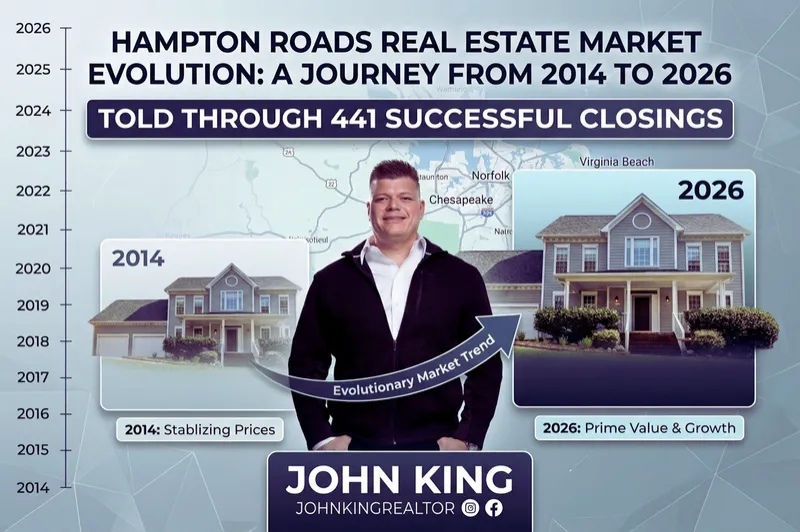
Written by John King, a U.S. Navy veteran and Berkshire Hathaway HomeServices RW Towne Realty REALTOR® with 441 closings across Hampton Roads, this library covers what buyers, sellers, and military families actually need to know about real estate in Virginia Beach, Norfolk, Chesapeake, and the surrounding 757.
Explore more than 200 original Hampton Roads real estate articles covering local neighborhoods, military PCS moves, VA loan strategy, home selling, waterfront property, market trends, and home buying — lessons drawn from more than 13 years of local transactions, not syndicated content.
Every guide is organized by topic below. Start with the cornerstone resources, browse a cluster, or scroll to the newest articles.
Start here
Start with these six cornerstone resources, then explore the supporting guides below.



Latest Hampton Roads Real Estate Articles
New guides and market updates are added every week. Newest first.

Most Profitable Month to Sell a House in Hampton Roads (2026)
In short: The best time to sell is when you are financially ready or need to move. Spring brings more buyers to Hampton Roads, but waiting months for it means mortgage payments, taxes, insurance, upkeep, and market risk that can cost more than any seasonal edge. This guide shows how seasonality works and how to weigh it against the cost of waiting.What Is the Most Profitable Month to Sell a House? Virginia Beach & Hampton Roads 2026 Guide
Quick Answer: Nationally, May and June have historically produced the strongest sale prices, and Hampton Roads follows a similar seasonal pattern. But the season is only one factor, and it is rarely the deciding one. If you are ready to sell in October, waiting until May usually means seven months of holding costs and market risk, which can easily outweigh a spring premium. I am John King, a Realtor with Berkshire Hathaway HomeServices RW Towne Realty with 441 closings in this market over 13 years. This guide explains the seasonal data, the real cost of waiting, and how to get top dollar whenever you list.
Why Timing Matters More Than Most Sellers Realize
The question of when to sell is not abstract — it is a dollar question. In a market like Hampton Roads, where the median home price is approximately $360,000 as of 2026, even a 2 to 3 percent swing in sale price equals $7,200 to $10,800. A 5 percent swing — entirely achievable through smart timing combined with the right pricing and marketing strategy — is $18,000 in your pocket or out of it, depending on the choices you make before you list.
Most sellers think about timing as a convenience question: when is it convenient for us to move? That is a legitimate consideration, but if you are not also thinking about timing as a financial strategy question, you are leaving money on the table. The market has seasonality. That seasonality creates real, measurable price and speed differences that I see in the REIN MLS data every single year.
What National Data Says About the Most Profitable Months to Sell
Nationally, research from ATTOM Data Solutions and the National Association of Realtors consistently identifies late spring — specifically May and June — as the period when sellers net the highest premiums above estimated market value. Here is what the data generally shows across major U.S. markets:
May is the single highest-performing month nationally for seller premiums, averaging 12 to 13 percent above estimated value in recent years. June is close behind. April is strong. The window from mid-April through mid-June represents the statistical sweet spot in most major markets — including Hampton Roads.
The reason for this pattern is rooted in buyer psychology and lifecycle timing. Many buyers want to close and be settled before the school year starts in September, which means they need to be shopping in spring, under contract by June, and closing by July or August at the latest. That creates a concentrated surge of highly motivated buyers entering the market in March, April, and May, which drives competition and lifts prices.
The Hampton Roads and Virginia Beach Market: Hyperlocal Timing Data
Virginia Beach and the broader Hampton Roads market follows the national seasonal pattern — but with important local variations that change the calculus for sellers here.
The military factor is the single biggest differentiator. Hampton Roads is home to Naval Station Norfolk — the largest naval installation in the world — along with Naval Air Station Oceana, Joint Base Langley-Eustis, and numerous other installations. Collectively, this region has one of the highest concentrations of active-duty military personnel in the United States. That means Hampton Roads has an overlay of military PCS (Permanent Change of Station) move cycles on top of the civilian seasonal pattern.
Military PCS orders are typically issued in January through March for June and July report dates. This means military buyers entering the Hampton Roads market to purchase homes are often doing so in March, April, and May — exactly aligned with the civilian spring buying season. The result is that the spring selling window in Hampton Roads is amplified compared to most other markets. More buyers. More competition. More upward pressure on prices.
Based on REIN MLS data that I track for my clients, here is how the Hampton Roads market typically performs by season:
March through June (Peak Season): This is the power window. Inventory turns fastest, offers come in quickest, and seller concessions are fewest. Homes listed in March and April are capturing the earliest motivated buyers — often military families with hard move deadlines — and frequently generating multiple-offer situations. May and early June see the highest volume of transactions and statistically the strongest prices relative to list price.
July and August (Transition): The market stays active but begins to soften. Many families have already purchased. Military buyers with June report dates are settled. The buyer pool shifts toward buyers without hard school-year or PCS deadlines, which typically means slightly longer negotiating windows and modestly more buyer leverage. Homes still sell — and sell reasonably well — but the competitive intensity of spring is fading.
September through November (Fall Season): Activity slows further. Days on market extend. Buyer demand is real but less urgent. This is the season where overpriced homes struggle and where motivated buyers can extract concessions from sellers who are tired of sitting on the market. For sellers, fall is survivable but not optimal.
December through February (Winter Season): Transaction volume drops to its seasonal low. The buyers who are active in December and January tend to be highly motivated — relocation buyers on tight timelines, investors, or buyers who have been searching for months and are finally ready to commit. Prices generally run below the spring peak. For a seller who can hold until spring, holding is almost always worth it financially.
The Specific Week That Performs Best in Virginia Beach
Research from Zillow and Realtor.com has identified that listing a home in the first two weeks of May — specifically between May 1 and May 15 — produces the highest probability of selling above list price and in the shortest time. In Hampton Roads, my transaction data aligns with this finding with one nuance: late March through early April can be equally powerful for military-heavy submarkets like Ocean Lakes, Kempsville, and the corridors near NAS Oceana and Naval Station Norfolk.
The practical implication: if you want to capture the peak of the peak, your home should be fully prepared and launched to the market by April 1 to May 15. That means your pre-listing preparation, photography, and marketing setup need to be complete before that window — which means you need to start working with your agent in February or early March at the latest.
I start pre-listing consultations with sellers 60 to 90 days before their target list date for exactly this reason. Waiting until March to decide you want to list in April almost always means you miss the window.
Peak Season Premium vs. the Cost of Waiting
The premium for spring timing in Hampton Roads is real and measurable. In my personal transaction history across 441 closings, homes I have listed in March, April, and May have consistently outperformed the equivalent homes listed in October through January on three key metrics: days on market, final sale price as a percentage of list price, and seller concession rates.
National data from ATTOM shows spring sellers capturing a larger premium over estimated value than winter sellers. That is a real pattern, but it is not money you automatically earn by waiting. Compare it to what waiting costs. If your total monthly cost to own is about $3,000 (mortgage, taxes, insurance, utilities, and upkeep), waiting from October to May costs roughly $21,000 before anything else changes. Meanwhile, rates, inventory, and prices can move against you; a 2 percent price dip on a $360,000 home is another $7,200. These figures are illustrative, so run your own numbers, but for most sellers who are ready now, listing now with the right price and marketing nets more than waiting for the calendar.
When Waiting for the Perfect Season Is a Mistake
Timing matters — but it does not matter more than execution. I have seen sellers wait for spring and then squander the advantage by overpricing their home, using poor photography, or choosing a passive marketing approach. I have also seen sellers list in October who received strong offers quickly because their home was priced correctly, presented beautifully, and marketed aggressively.
The season creates the conditions. Your agent's strategy determines whether you capture the full benefit of those conditions or leave money on the table despite listing at the right time of year.
Plenty of sellers should not wait for the peak window at all. Military sellers on PCS orders do not always have the luxury of timing the market. Estate situations have their own timelines. Job relocations create hard deadlines. Divorce, financial hardship, and health situations don't wait for spring. In every one of these scenarios, the right agent can still maximize your outcome — the strategy just has to be adapted to the circumstances.
The Hardest Months to Sell: November Through January
The flip side of peak season is the winter trough. Nationally, December, January, and the back half of November carry the highest days on market, the lowest sale-to-list ratios, and the most price reductions. December is the single hardest month in most markets: buyers are distracted by the holidays and year-end finances, school-year buyers closed months ago, and homes that do not sell quickly roll into January, which compounds the problem. January adds a "get my finances in order first" pause, expired pre-approvals, and rate recalculations. February is still in the trough; in Hampton Roads, real recovery in buyer traffic does not arrive until March.
Two local factors make winter harder here than the national pattern suggests. First, the military PCS cycle is asymmetric: June and July report dates drive heavy buyer activity from February through May, while December and January report dates produce a much thinner pool. Second, this is a military community with duty holidays, leave schedules, and family travel that cut housing search activity even more than the civilian slowdown. I have seen showings drop 50 to 70 percent in the two weeks around Thanksgiving and Christmas compared with spring Saturdays.
What the Winter Trough Costs in Dollars
In practical terms, "hard" means three things: days on market stretch from 7 to 14 days in April to 30 to 60 days in December; the buyer pool is smaller and knows it has leverage, so expect more requests for reductions, concessions, and repair credits; and price reductions become more likely and more visible, each one signaling weakness in the MLS.
Across my transaction history in Virginia Beach, Norfolk, and Chesapeake, the pattern is consistent with REIN MLS data. In the spring peak, a well-priced, well-marketed home in the $300,000 to $500,000 range typically draws multiple offers within two weeks and closes at 100 to 105 percent of list. In the winter trough, the same home draws one or two offers over 30 to 60 days and closes at 96 to 99 percent of list. Add the fact that winter list prices are usually set lower to begin with, and the compounding effect on a $360,000 Virginia Beach home can be a $20,000 to $40,000 difference in net proceeds, depending on neighborhood, condition, and competition.
Where the Winter Trough Bites Hardest
The oceanfront and Shore Drive corridor sees the sharpest winter discount of any Virginia Beach submarket, because so much of the value is lifestyle: a beach-adjacent home toured on a gray January day with an empty boardwalk gets systematically undervalued, and I have watched the same property draw offers 10 to 15 percent apart in December and May. Kempsville, Great Neck, and Centerville draw heavily from buyers timing a move around the school calendar, so their winter buyer pool is thin. Norfolk and Chesapeake have a broader, less military-dependent buyer mix and stay a little more active year-round, but Q1 listings there still underperform Q2 listings.
Selling in the Off-Season Anyway: Who Is Buying and How to Win
Sometimes winter is not a choice: PCS orders with hard report dates, estate timelines, job relocations, divorce, financial hardship, or a health situation. The goal then shifts from maximizing timing to maximizing execution inside a constrained window. And there is a real strategic case too. The buyers who are active from October through February are a small pool but a strong one: PCS families on orders, professionals on career moves, serious luxury buyers who know exactly what they want, buyers who lost out in spring bidding wars, and year-end buyers working backward from a December 31 closing. Every one of them is more decisive than the average spring shopper.
Lower inventory also works for the prepared seller. Instead of competing with 15 or 20 similar listings, you may be competing with four or five. A buyer who likes your home may not have three alternatives to tour first. Two committed buyers in November can drive a stronger outcome than five casual ones in May, and presentation carries more weight when there is less to look at. The rule is the same as always, just less forgiving: a well-priced, aggressively marketed home can still perform in December; an overpriced or passively marketed one will not.
When Waiting for Spring Actually Makes Sense
For most sellers the answer to "list now or wait" is list now, with three honest exceptions. If the home needs significant repairs that will not be finished until spring, a fall listing of an unready home is worse than a spring listing done right. If the property sits in a hyper-specific niche with a buyer pool measured in dozens, such as a very high-end waterfront estate, a strategic spring launch may fit better. And if your timeline is not urgent and you have a clear reason to prefer a spring closing, waiting can be fine, as long as you have counted the holding costs and understand you will be listing into a far more competitive field.
How I Time My Sellers' Market Entries for Maximum Profit
Every seller I work with gets a market timing analysis as part of my pre-listing consultation. This is not a generic seasonal recommendation — it is a specific assessment of your home, your neighborhood, your competition, and the current state of buyer demand in your price point.
Here is what that analysis looks like in practice. I pull 90 days of closed comparable sales in your specific neighborhood. I look at how days on market varied by list date, how final sale price as a percentage of list price varied, and what the active competition inventory looked like. I also look at the current supply-demand dynamic: with Hampton Roads active inventory running lean and pending sales up nearly 12 percent year-over-year as of early 2026, the market is favorable to sellers — but the advantage is most pronounced in the spring window.
For most Virginia Beach and Hampton Roads sellers whose situations allow for any timing flexibility, my recommendation is to target an April or May list date, prepare aggressively starting in January or February, and be ready to launch the moment the market signals peak buyer activity in your neighborhood. For sellers who need to move in winter or fall, I adapt the strategy accordingly — pricing more precisely to compensate for seasonal softness and marketing more aggressively to extract maximum demand from a smaller buyer pool.
Neighborhood-Specific Timing in Virginia Beach
Virginia Beach is not one market. It is dozens of micromarkets, each with their own buyer profiles, price points, and seasonal patterns. Timing that is optimal in one neighborhood is not necessarily optimal in another.
Oceanfront and Shore Drive corridor properties — the premium waterfront and near-waterfront segment — tend to have a slightly extended season that runs from March through July, because affluent buyers in this segment are less constrained by school-year move deadlines and more influenced by lifestyle and leisure considerations. A home on the water shows best in late spring and early summer when the amenity is at its most visually compelling.
Kempsville, Great Neck, and Centerville — the family-oriented, school-district-driven submarkets — tend to see the sharpest spring spike of any Virginia Beach neighborhoods, because buyers here are almost entirely motivated by school enrollment deadlines. April and May are the absolute peak for these areas.
The military-adjacent corridors near Oceana and Naval Station Norfolk see spring demand amplified by PCS activity, as I described above. March and April can be almost as strong as May in these areas because military buyers with June report dates start their searches in January and February.
Chesapeake and Suffolk — the inland markets to the west — follow a pattern closer to the national average, with May and June as the clear peaks and a sharper falloff in fall and winter compared to Virginia Beach proper.
What to Do Right Now to Capture Peak Season Profits
If you are reading this in late fall or winter and you are considering selling in 2026, here is your action plan. Contact me for a free home valuation and pre-listing consultation. In that meeting, we will determine your optimal list date based on your home, your neighborhood, and your personal timeline. We will develop a preparation plan — what to do, what not to do, and in what order — so that your home is in maximum condition when we launch. We will set up your marketing infrastructure so that on launch day, your home is not just entering the MLS — it is entering a market that has already seen it and is primed to respond.
If you are reading this in spring and you have been waiting, stop waiting. The window is open. Every week you delay in March, April, or May is a week of peak buyer traffic you are not capturing. Let us move.
Frequently Asked Questions: Profitable Home Sale Timing in Virginia Beach
Is spring really that much better than fall for selling in Virginia Beach?
Yes — the data is clear. Spring consistently produces shorter market times, fewer seller concessions, and higher sale prices as a percentage of list price compared to fall and winter. The military PCS overlay amplifies this effect in Hampton Roads beyond what most national markets experience.
Should I wait for spring if I am ready to sell now?
Usually not. Every month you wait carries holding costs and market risk, and fall and winter buyers tend to be serious and motivated. Correct pricing and strong digital marketing matter even more off-peak. Call me and we will compare listing now with waiting, using your actual numbers.
Does the day of the week I list matter?
Yes — Thursday or Friday listings consistently outperform Monday or Tuesday listings in Hampton Roads because buyers are searching and scheduling showings over the weekend. A Thursday or Friday launch means your home gets its critical first-weekend traffic immediately rather than sitting through a slow workweek before its first showing surge.
How do I know what my home is worth in today's market?
The only reliable way to know is a professional comparative market analysis from an agent who is actively transacting in your specific neighborhood. Automated estimates from Zillow and Redfin are notoriously unreliable in Hampton Roads. I provide free, no-obligation home valuations for Virginia Beach and Hampton Roads sellers — call me at (757) 270-3994 or visit 757king.com to get started.
Should I make renovations before listing in spring?
Some improvements return dollar-for-dollar or better; others do not. Fresh paint, professional cleaning, decluttering, and landscaping are almost always worth doing. Major renovations — kitchens, bathrooms, additions — rarely return their full cost at closing in Hampton Roads. In my pre-listing walk-through, I will tell you specifically which improvements will improve your outcome and which are unnecessary spending.
The Bottom Line: Timing Is a Strategy, Not a Guarantee
Seasonally, April and May tend to be the strongest months in Virginia Beach, but the most profitable time for you is usually when you are ready to sell, executed correctly. The season creates the opportunity. Your agent's pricing strategy, marketing system, and negotiation skill determine whether you capture that opportunity or let it pass.
With 441 closings in Hampton Roads, I have walked many sellers through this exact decision. I know this market — its seasonality, its military dynamics, its neighborhood-level nuances, and its 2026 conditions — better than virtually any agent working in this region. If you want to sell your home at the right time, in the right way, for the highest price the market will bear, let us have a real conversation.
📞 (757) 270-3994 | John King · KingRealtor757 · Berkshire Hathaway HomeServices RW Towne Realty · Virginia Beach, VA · 757king.com
About the Author: John King is a U.S. Navy veteran and full-time Realtor with Berkshire Hathaway HomeServices RW Towne Realty, serving Virginia Beach, Norfolk, Chesapeake, and all of Hampton Roads. With 441 closings and 13 years of hyperlocal market expertise, John has earned the HRRA Circle of Excellence Award 11 consecutive years and has earned a top 1–3% ranking from Berkshire Hathaway HomeServices RW Towne Realty. He is the #1 individual listing and sales agent in his office every year since 2015. Learn more at 757king.com or call (757) 270-3994.
Thinking about a sale of your own? Start with how I sell Hampton Roads homes, proven across the 13 year Hampton Roads transaction study.
Related Reading: Sell My House in Virginia Beach: The Complete 2026 Seller's Guide | How to Sell My House Fast in Virginia Beach | Can You Sell a House in Virginia Without a Realtor?
Related guides from John King
Written by John King, Navy veteran & REALTOR®, Berkshire Hathaway HomeServices RW Towne Realty · (757) 270-3994 · About John

Why these guides are different
Every article here is written by one local agent from his own transaction record, not by a content farm. The numbers below are the basis for the advice.

John King is a former Navy Machinist Mate and a licensed Virginia REALTOR® with Berkshire Hathaway HomeServices RW Towne Realty in Virginia Beach. Licensed since 2013, he has logged 441 closings across Virginia Beach, Norfolk, Chesapeake, Suffolk, Hampton, and Newport News, and specializes in military PCS relocation, VA loans, and waterfront property. He holds a 5.0 Google rating across 117 reviews and has earned the HRRA Circle of Excellence every year since 2015.
About John King See the transaction studyCommon questions about this library
Tap a question to expand it.
What is the Hampton Roads Real Estate Blog?
Which Hampton Roads neighborhoods are closest to each base?
How do VA loans work when buying in Virginia Beach or Norfolk?
What is the Hampton Roads real estate market like right now?
Should I buy or rent during a PCS to Hampton Roads?
Ready to talk about your move?
Reading is a good start. A 15-minute conversation with a local agent who has logged 441 closings in Hampton Roads is a better one.
Prefer to talk? Call or text John at (757) 270-3994.

441 Closings
Client-side closings across Hampton Roads since 2014.

189 VA-Financed Sales
Direct experience with military and veteran buyers.

270 Subdivisions
Experience spread across the whole region.

FOLLOW US


COMPANY
CUSTOMER CARE
LEGAL
Copyright 2026 John King | KingRealtor757. All Rights Reserved. Equal Housing Opportunity. REALTOR(R). Virginia License 0225211050.