







Hampton Roads Real Estate Blog & Local Market Insights
Written by John King, a U.S. Navy veteran and Berkshire Hathaway HomeServices RW Towne Realty REALTOR® with 441 closings across Hampton Roads, this library covers what buyers, sellers, and military families actually need to know about real estate in Virginia Beach, Norfolk, Chesapeake, and the surrounding 757.
Explore more than 200 original Hampton Roads real estate articles covering local neighborhoods, military PCS moves, VA loan strategy, home selling, waterfront property, market trends, and home buying — lessons drawn from more than 13 years of local transactions, not syndicated content.
Every guide is organized by topic below. Start with the cornerstone resources, browse a cluster, or scroll to the newest articles.
Start here
Start with these six cornerstone resources, then explore the supporting guides below.




Latest Hampton Roads Real Estate Articles
New guides and market updates are added every week. Newest first.
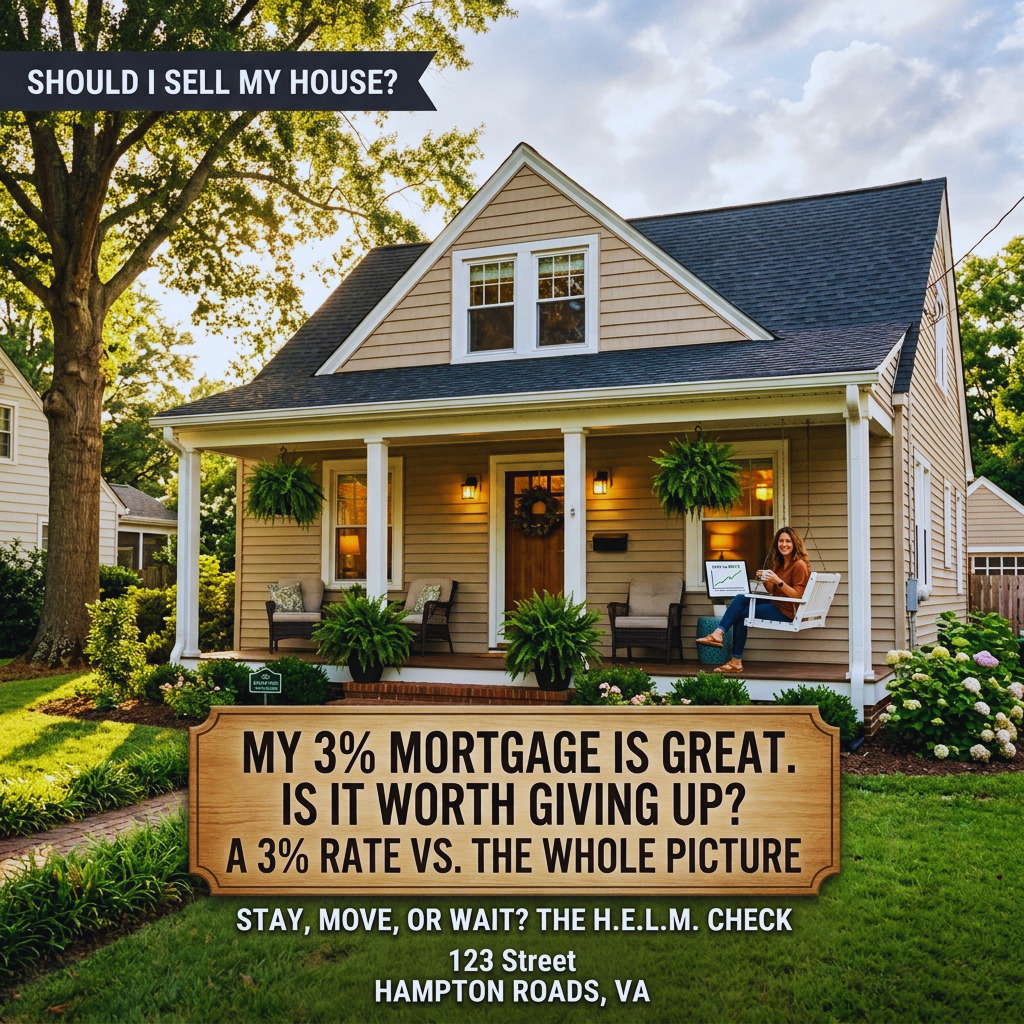
Should I Sell My House If I Have a 3% Mortgage?
Maybe. And maybe not.
That answer frustrates people, so let me give you the honest version up front. A low mortgage rate is real financial value, and you give it up when you sell. So the question is not whether your rate is good. It is whether everything else you would change by moving is worth more than that rate.
For a homeowner with little other debt, in a home that still fits their life, staying usually wins on the numbers. For a homeowner carrying expensive consumer debt alongside a lot of equity, the picture can flip completely.
The most common thing I hear from Hampton Roads homeowners in 2026 is some version of "I cannot move, my rate is too low." I hear it so often that I built a free tool to answer it: the H.E.L.M. Check, a stay, move or wait calculator that compares your real numbers side by side. Nothing gated, nothing saved, no sign up.
This article walks through the thinking behind it, because the honest answer to the 3% mortgage question depends on far more than one number.
The Lock-In Effect Is Real. It Is Also Only Half the Math.
Economists call it the mortgage rate lock-in effect: homeowners who locked in rates near 3% during 2020 and 2021 are reluctant to sell, because replacing that loan at today's rates means a significantly higher payment on the same money.
That reluctance is rational. A 3% mortgage next to a market where the Freddie Mac 30 year fixed average sits above 7% is a genuine financial asset. Anyone who tells you to ignore it is not doing honest math.
But here is what the lock-in conversation almost always misses. Your mortgage rate is only one of the rates you pay. And for a lot of households, it is not even the biggest one.
The Question Is Not "What Is My Mortgage Rate?" It Is "What Is My Whole Picture?"
Picture a homeowner who says, "I have a 2.875% mortgage. I would be crazy to sell."
Now suppose that same household also carries $85,000 on credit cards, a $60,000 HELOC, two car payments, a roof near the end of its life, little savings, and several hundred thousand dollars of equity sitting in the house.
The mortgage rate is cheap. The household's overall financial structure is not.
This is why the H.E.L.M. Check calculates what I call a Life Rate: the balance weighted average interest rate across everything you owe, mortgage included. A 2.875% mortgage sitting next to $145,000 of double digit consumer debt can produce a Life Rate several times higher than the mortgage rate alone.
The Life Rate is an educational number, not an APR or a lending metric. What it does is make one thing visible: the low rate on your mortgage may be protecting less of your financial life than you think.
There Are Three Costs to Consider, Not One
Most people weigh only the cost of moving. That is half the math. There are actually three costs on the table, and the honest comparison looks at all of them.
The cost of moving. A higher mortgage rate on the next loan. Selling and buying transaction costs. Moving expenses. Different taxes, insurance and HOA. Using equity that could have stayed put.
The cost of staying. High interest consumer debt that keeps compounding. HELOC and car payments. Repairs and maintenance on a home that may not fit anymore. A commute, a layout or a location that wears on you daily. Space you no longer need, or space you badly need.
The cost of waiting. More months of interest on consumer debt. Another year of the same commute or upkeep. Prices and rates that can move in either direction. Delayed downsizing, delayed closeness to family. Postponing a move that orders may force anyway.
Waiting can also be the smartest move. It can buy time to pay down debt, build reserves, improve credit, prepare the house for sale, or figure out where you actually want to live next. The point is not that any one path is right. The point is that each path has a cost, and most people only ever price one of them.
When Staying Usually Wins
Let me be direct about this, because a Realtor writing about whether you should sell has an obvious bias to manage, and the only way I know to manage it is to put the staying case in writing.
Staying usually wins on the numbers when:
Your other debt is modest or zero
Your home still fits your household, your commute and your stage of life
Your monthly picture is comfortable, not tight
Nothing about your life is pushing a timeline
A homeowner with a 2.75% mortgage, one small car loan and a home that still works is almost always in a stronger position staying put. Moving would roughly double their housing payment to change things that were not broken. The H.E.L.M. Check is built so that staying can win, and for homeowners like this, it does. Plainly.
If that is your situation, the most valuable thing this article can tell you is that you already have your answer, and you did not need to give a Realtor your phone number to get it.
When the Picture Can Flip
The math starts changing when substantial equity sits next to expensive debt.
Hampton Roads homeowners who bought years ago are often holding six figures of equity. At the same time, some of those same households carry credit cards at rates above 20%, HELOCs, car loans and personal loans that consume a large share of every month's income.
For some of those households, selling can lower total monthly obligations even at a higher mortgage rate, because sale proceeds can eliminate the expensive debt entirely while the equity funds the next move. For others, it clearly cannot, because the next home's full cost, including taxes, insurance and transaction costs, eats the benefit.
There is no rule of thumb that resolves this. The only honest way to know is to compare staying, moving and waiting with your real numbers. That is exactly what the H.E.L.M. Check does: Housing costs, Equity, Life fit and Money owed, compared side by side, with a stress test that shows what rate, price or down payment would have to happen for the two paths to cost the same.
Do not predict. Stress test. Then decide.
The Numbers Are Not the Whole Decision
I have closed 441 transactions across 13+ years in Hampton Roads, through four very different markets, and I can tell you that almost no one moves purely on a spreadsheet.
Some costs never show up on a statement. A commute that eats two hours a day. A house the kids have outgrown, or one that is now three empty bedrooms of maintenance. Aging parents two states away. A layout that fights you daily. The low grade stress of a monthly picture that is technically manageable and never comfortable.
A housing decision will not solve every personal problem, and anyone who sells you that idea is selling. But changing the financial structure around a home can sometimes remove one major source of pressure. That is worth understanding clearly before you decide either way, which is why the H.E.L.M. Check includes an optional Life Check alongside the math.
What I Would Tell You If You Called Me Today
If you are sitting on a 3% mortgage and wondering whether you are stuck, here is the process I would walk you through.
First, run your numbers. Use the free H.E.L.M. Check. It takes a few minutes, nothing is saved, and the sample scenarios let you see how different situations play out before you enter your own.
Second, get a real number on your home. The calculator uses your estimate of value. An actual answer comes from current comparable sales on your streets, which is what a free home valuation gives you. In a market where well priced homes are still moving quickly, the difference between your guess and the real number can change the whole comparison.
Third, if your situation involves significant debt stress, talk to the right professionals early. Your mortgage servicer and a HUD approved housing counselor should hear from you before a missed payment, not after, because earlier conversations leave more options. A Realtor adds one piece to that picture: what your home could actually sell for, and what each housing option would really look like.
And if the answer is stay? Then stay. I will tell you that, and the tool is built to tell you that. Knowing you are in the strongest position with real numbers behind you is worth something too.
Frequently Asked Questions
Am I crazy to give up my low mortgage rate?
Not necessarily, and not necessarily right either. Your mortgage rate is one of several rates you pay. If your Life Rate, the weighted rate across everything you owe, runs far higher than your mortgage rate, the low rate may be protecting less than you think. The comparison, not the rate, answers the question.
Can a higher mortgage rate still leave me with lower monthly payments?
Yes, in some situations. A homeowner with substantial equity and high interest consumer debt may be able to use sale proceeds to eliminate other payments entirely. Whether total monthly obligations actually drop depends on the next home price, the loan terms, transaction costs, taxes, insurance and how the equity is used. It has to be calculated, not assumed.
What mortgage rate would make moving worthwhile for me?
It depends on your full picture, which is why the H.E.L.M. Check solves for it. Enter your numbers and it calculates the rate, purchase price or extra down payment at which moving and staying would cost the same each month. That break even number is more useful than any forecast.
What if rates fall but prices rise?
Then a lower rate can be offset by a higher price, which is exactly why predicting is a poor strategy. The stress test shows rate and price separately, so you can see which one your situation is more sensitive to.
What does H.E.L.M. stand for?
Housing costs, Equity, Life fit and Money owed. Those are the four inputs the calculator uses to compare staying, moving and waiting. The name comes from the helm of a ship, where the course gets decided.
Will the calculator tell me to sell?
No. It never tells you to sell, buy or move. It shows estimated tradeoffs, explains what changed between the scenarios, and shows what would have to change for each path to make sense. The decision stays yours.
What if staying is actually the best answer?
Then stay. The tool is built so staying can win, and it often does for homeowners with low rates, modest debt and a home that still fits. Knowing that with real numbers behind you is worth something too.
Run Your Own Numbers
The 3% mortgage question does not have one answer. It has your answer, and it lives in your numbers.
Start with the free H.E.L.M. Check. If you want the comparison run against your actual Hampton Roads property, with current comparable sales, a likely selling range and real estimated proceeds instead of estimates, reach out and tell me you ran the H.E.L.M. Check. No obligation. And if the answer is stay, I will tell you that.
Related Reading
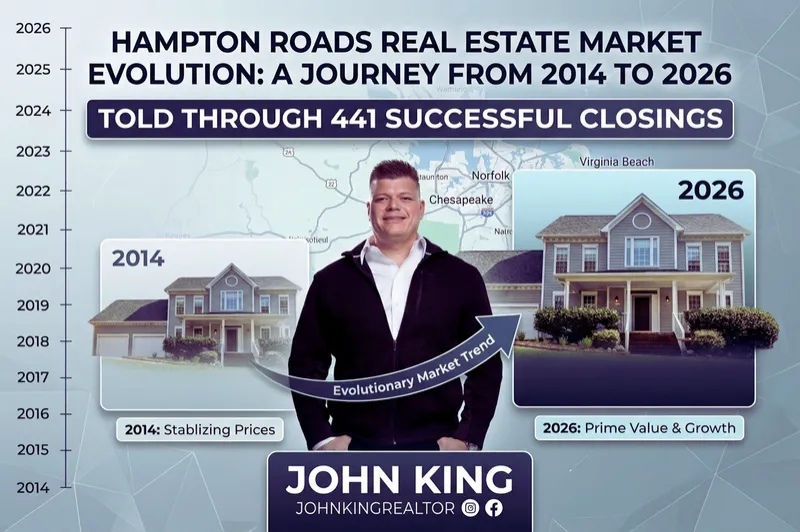
Four Eras, Same Agent: How the Hampton Roads Real Estate Market Rewrote Itself Between 2014 and 2026
About The Author
John King is a U.S. Navy veteran and licensed Realtor with Berkshire Hathaway HomeServices RW Towne Realty, serving Hampton Roads including Virginia Beach, Norfolk, and Chesapeake. A designated Luxury Collection Specialist with more than 400 closings and over 13 years of local experience, he is known for a strategic, data driven approach to marketing homes and a straightforward, veteran's approach to his clients.
📱 757-270-3994
📧 [email protected]
🌐 www.757King.com
▶️ Hampton Roads Living on YouTube
Curious what your home is worth in today's market? Get a free home valuation and find out where you stand.
This article and the H.E.L.M. Check are educational real estate scenario tools. They are not financial, tax, legal or credit counseling advice, a mortgage approval, a loan estimate, an appraisal, a guarantee of sale price or proceeds, or a prediction of future home values or mortgage rates. The Life Rate is an educational calculation, not an APR, a lending quote or a recognized financial industry metric. Every situation is different, and results depend entirely on your actual numbers. If you are facing significant debt or possible default, consult appropriately licensed professionals, including your mortgage servicer and a HUD approved housing counselor.

Why these guides are different
Every article here is written by one local agent from his own transaction record, not by a content farm. The numbers below are the basis for the advice.

John King is a former Navy Machinist Mate and a licensed Virginia REALTOR® with Berkshire Hathaway HomeServices RW Towne Realty in Virginia Beach. Licensed since 2013, he has logged 441 closings across Virginia Beach, Norfolk, Chesapeake, Suffolk, Hampton, and Newport News, and specializes in military PCS relocation, VA loans, and waterfront property. He holds a 5.0 Google rating across 117 reviews and has earned the HRRA Circle of Excellence every year since 2015.
About John King See the transaction studyCommon questions about this library
Tap a question to expand it.
What is the Hampton Roads Real Estate Blog?
Which Hampton Roads neighborhoods are closest to each base?
How do VA loans work when buying in Virginia Beach or Norfolk?
What is the Hampton Roads real estate market like right now?
Should I buy or rent during a PCS to Hampton Roads?
Ready to talk about your move?
Reading is a good start. A 15-minute conversation with a local agent who has logged 441 closings in Hampton Roads is a better one.
Prefer to talk? Call or text John at (757) 270-3994.

441 Closings
Client-side closings across Hampton Roads since 2014.

189 VA-Financed Sales
Direct experience with military and veteran buyers.

270 Subdivisions
Experience spread across the whole region.

FOLLOW US


COMPANY
CUSTOMER CARE
LEGAL
Copyright 2026 John King | KingRealtor757. All Rights Reserved. Equal Housing Opportunity. REALTOR(R). Virginia License 0225211050.