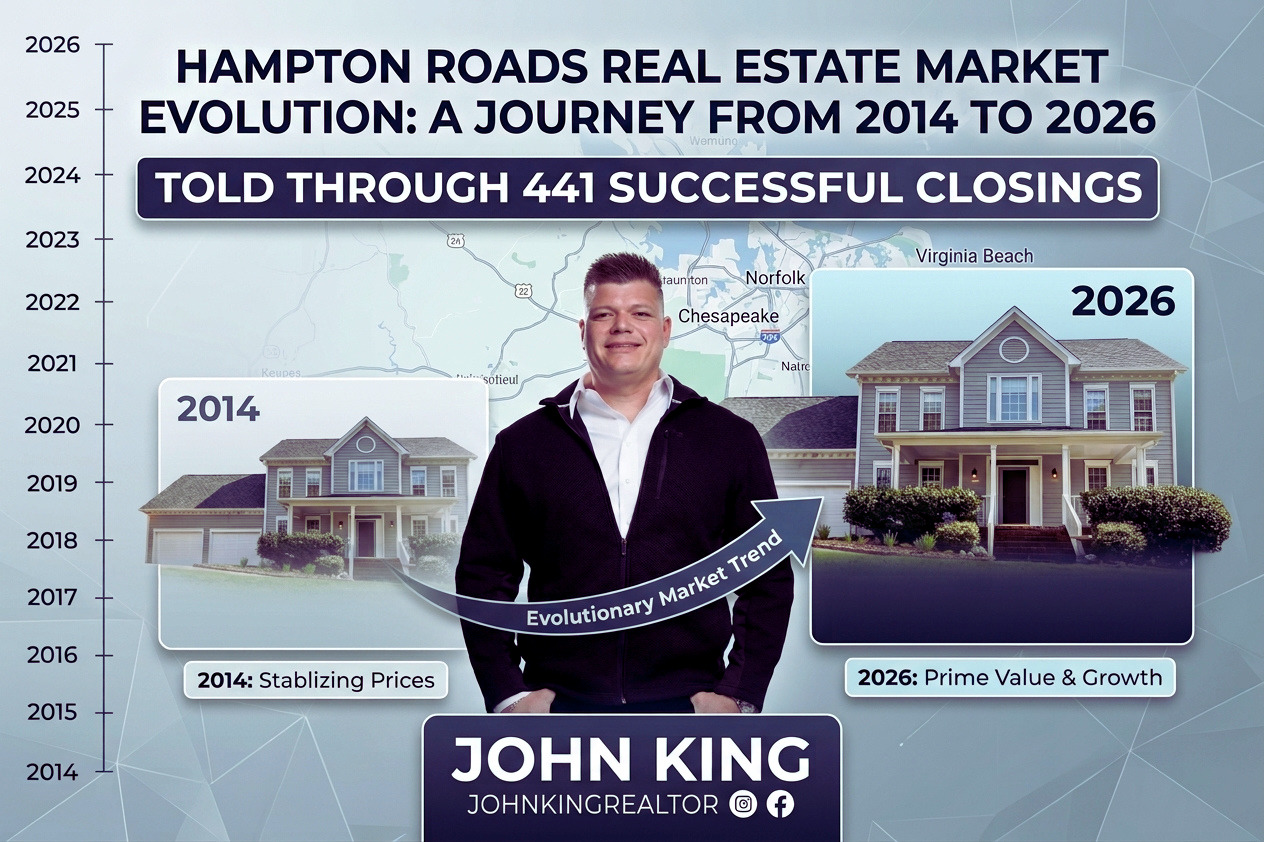
Hampton Roads Real Estate: Four Eras From 2014 to 2026
In short: Hampton Roads has really been four different markets since 2014: the slow recovery, the pre pandemic normal, the 2020 to 2022 frenzy, and today's normalized market. Each era rewarded different strategies, and knowing which market you are actually in is the foundation of pricing and negotiating well. I have closed homes in all four.In 2014, not a single home I closed sold above the asking price. Not one. By 2022, half of them did.
That is not a market that got busier. That is a market that became an entirely different game. And I have been the constant across all four versions of it.
Over the last 13 years I have closed 441 residential transactions in Hampton Roads, totaling roughly 141.7 million dollars in volume. The full record is published on my site, deal by deal, so you do not have to take my word for any of the numbers in this piece. What that record shows, more than anything else, is that Hampton Roads has not had one real estate market since 2014. It has had four, and each one has demanded a different set of instincts from anyone trying to buy or sell a home here.
If your mental model of this market was formed before 2018, it is calibrated to a market that no longer exists. If it was formed during the 2020 to 2021 frenzy, it is calibrated to a market that no longer exists either. The numbers below tell you why, and what it costs a seller or a buyer to work off the wrong picture.
Why Four Eras Matters
Real estate advice ages badly here. The playbook that worked in 2015 loses you money in 2025. The pricing instinct that fit 2020 misfires in 2026. Anyone who tells you the Hampton Roads market has been steady over the last decade has not been watching closely, or has not been through enough deals to see the pattern.
The published summary of my 441 MLS recorded closings groups my book into three windows, and here is what those three published windows look like:
Window | Median days on market | Share sold above asking |
|---|---|---|
2014 to 2017 | 55 | 8% |
2018 to 2021 (combined) | 29 | 28% |
2022 to 2026 | 12 | 43% |
But that middle window, 2018 through 2021, hides two very different markets stacked on top of each other. The 2018 and 2019 market was a tightening market. The 2020 and 2021 market was a frenzy the region had never seen before and has not seen since. Anyone who lived through both knows they were not the same thing, and any seller relying on 2020 price memories to set a 2026 list price is bringing the wrong map to the meeting.
So the honest version of my book breaks into four eras, not three. Let me walk you through each one.
Era 1: 2014 to 2017. The Patient Market.
When I started closing deals in Hampton Roads in 2014, the median home I sold sat on the market for 92 days before going under contract. Ninety two. Buyers had weeks, sometimes months, to think it over. They walked homes twice. They negotiated on price. They negotiated on repairs. And zero percent of my 2014 closings sold above their asking price.
Across the full 2014 to 2017 window, the median time to contract was 55 days, and only 8 percent of my closings crossed the ask.
The deals themselves reflected that era. The average home I closed in 2014 sold for around 188 thousand dollars. My book was heavy on entry level and mid tier properties: brick ranches and Cape Cods in Kempsville, postwar homes in Ocean View and Bayview, starter homes in Bayside, family homes in Ocean Lakes, and the close to base neighborhoods around Wards Corner like Suburban Acres and Pinehurst. VA loans and FHA loans dominated. Cash was rare. Condition was everything, because a buyer using a government backed loan cared what the appraiser found.
That was the era that built the muscle. When you close 30 or 40 homes a year in that kind of market, you learn how to prep a house so it clears a VA appraisal without a repair fight. You learn how to negotiate patiently, because the buyer is not going anywhere. You learn how to price a home so it sells, rather than sits, because the market will punish you slowly and expensively if you get it wrong. And you learn the neighborhoods, block by block, because the differences between them shaped every conversation with a buyer.
If the only market you have ever worked is the last three years, you never learned any of that. Which is fine, until the market shifts again and those skills matter.
Era 2: 2018 to 2019. The Shift Begins.
Somewhere in 2018, the rhythm changed. Inventory started tightening. Buyers who had been comfortable seeing a home three times before writing an offer started seeing that pace cost them the deal. Multiple offers, which had been rare, became a regular part of a busy weekend on any well priced home. The market had not gone wild yet, but the patience of Era 1 was gone.
This is the period my book started densifying along the Shore Drive corridor and other coastal pockets that were starting to attract more competitive demand. The bayfront condominium buildings, Cape Henry Towers, Chesapeake House, and Harbour Gate, and neighborhoods from Chic's Beach to Lynnhaven Colony to Cape Story by the Sea moved from steady to genuinely competitive. Sellers who priced correctly moved quickly. Sellers who tested the market with an ambitious number sat, reduced, and eventually met the market anyway.
Buyer behavior changed too. In Era 1, a buyer might see 15 homes over three weekends before writing an offer. In 2018 and 2019, that same buyer might see three homes on a Saturday and be under contract by Sunday, often against multiple bidders. The word for what buyers were doing became urgency. The word for what sellers had to do became strategy.
None of it prepared anyone for what came next.
Era 3: 2020 to 2021. The Frenzy.
Then the pandemic hit. Interest rates fell to levels no one alive had ever seen. Refinancing exploded. Buyers who had never seriously considered a coastal Virginia move suddenly wanted in, and buyers who had been thinking about it for years decided the moment was now. Inventory stayed thin. Demand went vertical. And Hampton Roads real estate did something in 2020 and 2021 that it has not done before or since.
Houses sold fast, in almost any condition, as long as they were priced right. Most listings drew multiple offers. On the busiest weekends, it was not unusual to see a line of eight or ten people waiting at the front door of a home for a scheduled showing. Homes routinely sold over their list price, and buyers who wanted to win learned to write offers with few asks, or none. Inspection contingencies waived. Appraisal gaps covered. Escalation clauses stacked. Whatever it took to get the yes.
I watched deals close in days that would have taken months in Era 1. I watched sellers who priced correctly get their number and more, and I watched buyers who hesitated for a weekend lose the house they thought they had won. My book densified further along the Shore Drive corridor during this period. It is the stretch during which I sold four separate units in a single high rise building.
The Frenzy was the market that most reset expectations, in both directions. Sellers who transacted during those two years remember prices and pace that felt like a permanent new normal. Buyers who transacted during those years remember paying whatever it took, and now wonder whether they overpaid. Both memories are the memories of a specific market that ended, and any seller pricing a 2026 home off a 2021 neighbor's sale is bringing outdated information to the table.
Era 4: 2022 to 2026. The Rate Shock and the Speed Market.
Then rates jumped, and the consumer was shocked.
Buyers who had been shopping at 3 percent mortgages suddenly faced 6 and 7 percent. Payments recalculated. Some buyers stepped back. Sellers who had been counting on Frenzy pricing had to recalibrate. For a few months in mid to late 2022, the market held its breath.
Then it kept moving. Not the way it moved in 2020 and 2021, but not the way it moved before either. Inventory stayed tight. Serious buyers, especially military families PCSing in on VA loans, kept transacting. The frenzy pace of multiple offers cooled for most properties but did not disappear on well priced ones. The result across the full 2022 to 2026 window is a median time to contract of 12 days in my book and 43 percent of my closings crossing the asking price. In 2026 alone, the median home I closed sat on the market for six days before going under contract. Six. That is not a market. That is a game clock.
The composition of my book climbed alongside the pace. My 2025 closings averaged just over 498 thousand dollars, more than two and a half times the 2014 average. Nine of my closings in this era sold above 750 thousand dollars. Five were above a million. My work in Alanton, Bay Colony, Princess Anne Hills, and the North End deepened as more buyers moved into the upper tier of the market. On the Norfolk side, the luxury waterfront came into its own, pulling buyers into Larchmont and Edgewater, Lochaven, Ghent, and West Freemason, where a fully renovated historic home now trades in a band that would have seemed unlikely a decade earlier.
The Era 4 buyer is different from the Frenzy buyer. This one runs a payment calculator before writing an offer. This one wants an inspection. This one is not going to waive an appraisal gap on the off chance it wins the deal. And this one still moves fast when the right home hits, because the market rewards speed and punishes hesitation.
This is the era that especially rewrites the luxury seller playbook. At the upper end of the market, buyer pools are thinner, marketing has to reach further, and the difference between a home that sells at the top of its band and a home that lingers through two price reductions comes down to positioning that starts long before the sign goes in the yard.
What Stayed the Same
Four eras. Four completely different markets. One constant.
Across all 13 years, my book has covered the full range of Hampton Roads real estate. 189 VA loan closings, 140 conventional financing, 49 FHA, and 41 all cash. 98 condos and townhomes alongside 330 detached homes. 72 sales under 200 thousand dollars and 30 above 600 thousand. 270 distinct subdivisions. 44 ZIP codes. 8 cities. 116 of those closings went under contract within a week. 121 sold above the asking price.
I have priced entry level condos and waterfront estates in the same year. I have negotiated with cash investors and first time VA buyers inside the same month. I have closed remote sales for families PCSing in from overseas and I have handled patient marketing on properties that needed to find exactly the right buyer.
What has held across all four eras is the approach. Price to the actual market, not to what a seller wishes it were, and not to what the market was doing two years ago. Prepare a home so its strengths lead and its weaknesses do not derail the deal. Position the home as a product that buyers should compete for, not as a listing that waits to be discovered. Communicate honestly with clients about what the market is doing today and what their specific home should do inside it.
That is the work I do the same in every era. What changes is the tempo, the pricing bands, and the specific plays that fit the moment. The framework does not.
What This Means for You Today
Here is the practical takeaway.
If you formed your understanding of Hampton Roads real estate during Era 1 or Era 2, some of your instincts are wrong for Era 4, and they will cost you money in either direction. If you formed it during Era 3, the Frenzy, some of your instincts are wrong in the other direction, and those will cost you money too. Sellers who price to a 2021 neighbor's sale are asking for a number the market has moved past. Buyers who wait for the frenzy to come back are missing homes today. Anyone whose mental model of this market was set in a different era is running an outdated map.
That is true even at the top of the market. Especially at the top. A luxury seller in 2026 is not selling into the same buyer pool a luxury seller faced in 2018, or in 2021, and the marketing and pricing strategy that fit those earlier moments does not fit this one.
Working with an agent who has priced, marketed, and negotiated across all four of these eras is not about impressive numbers on a homepage. It is about pattern recognition. Knowing which situation you are actually in. Knowing how buyers here move today, not how they moved in a different market. And knowing which of the playbooks in the file actually fits your specific home, your specific neighborhood, and this specific week of this specific market.
Let's Talk
If you are thinking about selling a home in Hampton Roads and you want a current era read on what your home should do, let's have that conversation. I will give you a straight look at the neighborhood data, the pricing strategy that fits, and the positioning plan that gets you the outcome the market will actually reward, without the guesswork and without the wait.
The full 13 year record is on my site if you want to read it before we talk. Everything on this page comes from it.
Related Reading
About the Author
John King is a U.S. Navy veteran and licensed Realtor with Berkshire Hathaway HomeServices RW Towne Realty, serving Hampton Roads including Virginia Beach, Norfolk, and Chesapeake. A designated Luxury Collection Specialist with more than 400 closings and over 13 years of local experience, he is known for a strategic, data driven approach to marketing homes and a straightforward, veteran's approach to his clients.
📱 757-270-3994
📧 [email protected]
🌐 www.757King.com
▶️ Hampton Roads Living on YouTube
Curious what your home is worth in today's market? Get a free home valuation and find out where you stand.
Related guides from John King
Written by John King, Navy veteran & REALTOR®, Berkshire Hathaway HomeServices RW Towne Realty · (757) 270-3994 · About John
