West Freemason: Norfolk's Oldest Waterfront Neighborhood
West Freemason: Norfolk's Oldest Waterfront Neighborhood
West Freemason is the oldest standing neighborhood in Norfolk, Virginia, a compact waterfront district on the Elizabeth River where cobblestone streets, gas era architecture, and three centuries of history sit minutes from downtown. For a seller, it is one of the most distinctive addresses in the city, a place where a home is not just a house on the water but a piece of Norfolk's founding story. This is the second post in our Norfolk luxury waterfront series, and the first deep dive into a single neighborhood.
The Oldest Ground in Norfolk
West Freemason's history reaches back nearly to the founding of the city itself. In 1686, one hundred acres in this vicinity were granted to the Elizabeth River Parish as a glebe, land set aside to support the parish. In 1734 the vestry sold that land to a merchant named Samuel Smith. It became one of the first areas of Norfolk to develop outside the boundaries of the original fifty acres of the colonial town. In other words, when Norfolk began to grow beyond its earliest footprint, this is where it grew first.
The neighborhood takes its name from an early Masonic lodge that stood on Freemason Street in the 1700s. That name has outlasted nearly everything else from the era, which is fitting for a place whose entire identity is bound up in endurance.
Destroyed, Burned, and Rebuilt
West Freemason's story is one of survival. On January 1, 1776, during the Revolutionary War, British bombardment and the fires that followed destroyed over half of Norfolk, including most of Freemason. What the British did not raze, patriot forces burned in the weeks after as a strategic measure. The city was left in ruins, and West Freemason has the distinction of being among the first areas rebuilt afterward.
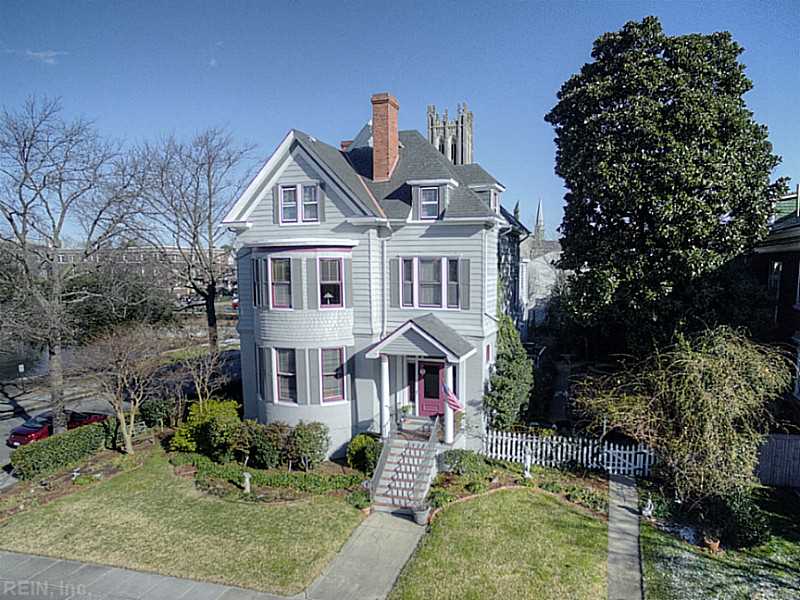
Reconstruction of the original neighborhood was not completed until the middle of the nineteenth century, and the homes that rose tell that long story in brick and stone. Today West Freemason is the only neighborhood in the city that presents a visible chronology of architectural styles across three centuries. The 1791 Taylor Whittle House stands as an example of the Federal style. Other homes show Greek Revival, Italianate, Second Empire, Romanesque Revival, Beaux Arts, Queen Anne, and Georgian influences. In 1850, the city's first gas lamps were installed along Freemason Street. Through the nineteenth and early twentieth centuries, this was one of Norfolk's finest residential neighborhoods, and it retains the cobblestone paving, granite curbs, cast iron fences, and brick sidewalks that defined early Norfolk.
Decline and the Fight to Survive
The twentieth century nearly erased it. As public transit expanded in the early 1900s, residents moved further from the center city, and West Freemason entered a long period of neglect. During both world wars, large homes were carved up into boarding houses for shipyard, military, and defense workers. By the 1950s, many historic homes had fallen into disrepair and were demolished to make room for parking lots and newer construction.
The decisive moment came in the 1960s, when a freeway was proposed along the neighborhood's waterfront. Remaining residents understood that if the road went through, the neighborhood would effectively disappear. Working with the Norfolk Redevelopment and Housing Authority, they organized, fought the highway, and won that fight in 1968. The victory led to a conservation zoning district for West Freemason, the formation of the Freemason Street Area Association in 1976, and, in 1972, the neighborhood's entry into the National Register of Historic Places.
What followed was one of the more sustained revitalizations in the city's history. Since the 1980s, the city and the Norfolk Redevelopment and Housing Authority have invested more than 156 million dollars to revitalize the neighborhood, replacing the original industrial waterfront and vacated parcels with townhouses, condominiums, businesses, and public green space that complement the historic core. In 2013, the American Planning Association named West Freemason one of its Great Neighborhoods in America, a national recognition of exactly the qualities that nearly vanished half a century earlier.
The Waterfront Today
West Freemason is bounded by the Elizabeth River to the west and south, which is the heart of its appeal. The neighborhood wraps around Freemason Harbor and looks out on The Hague, the horseshoe shaped inlet of the Elizabeth River that it shares with the adjacent Ghent district, where the grand homes of Mowbray Arch line the far bank. The Pagoda and Oriental Garden, a two story marine observation tower given by Taiwan in 1989 to honor trading ties with Virginia, anchors the waterfront at Friendship Park. The Elizabeth River Trail runs along the southern border, and a stop on Norfolk's Tide light rail, completed in 2011, sits at York Street and Freemason near the north end of the neighborhood. The Elizabeth River Ferry connects the waterfront to Old Town Portsmouth across the river.
The result is a neighborhood that delivers something rare: genuine historic character, true waterfront, and a walkable connection to downtown's restaurants, museums, and harbor, all in the same few blocks.
What This Means for Sellers
For a seller, West Freemason offers a value proposition that very little of the Norfolk market can match, and that is precisely why it rewards specialized representation.
The inventory falls into two distinct camps. The first is the historic single family homes along the cobblestone streets, the turn of the century and older residences with the moldings, high ceilings, and architectural pedigree that buyers at this level specifically seek. The second is the waterfront condominium communities along Freemason Harbor and the river. Freemason Harbour Condominiums, a building completed in 1986 with roughly fifty units, offers river views and a deep water marina. Harbour Place occupies the former Boush Cold Storage Warehouse and was among downtown Norfolk's first condominium conversions, an example of the industrial reuse that defined the neighborhood's rebirth. On The Hague waterfront, renovated turn of the century homes have recently traded in the mid seven hundred thousands, a reminder that the historic housing on the water commands a real premium.
Pricing in a neighborhood like this is not a matter of pulling comparable sales and averaging them. The homes are individual, the waterfront parcels are scarce, and the buyer pool is particular, often drawn to the history as much as the square footage. A maintained historic home on a cobblestone block, a condominium with a deep water slip, and a renovated residence on The Hague are three different products that reach three different buyers. Positioning each one correctly, telling its specific story, and reaching the narrow audience that values it is the work that determines the final number. That is what a Luxury Collection Specialist brings to a listing here.
Key Facts: West Freemason at a Glance
Location: Norfolk's oldest neighborhood, bounded by the Elizabeth River to the west and south, just west of downtown
Founded: Land granted as a parish glebe in 1686, sold into private hands in 1734, among the first areas developed beyond Norfolk's original fifty acres
Destroyed and rebuilt: Most of the neighborhood was destroyed in 1776 during the Revolutionary War and was among the first areas of Norfolk rebuilt
Architecture: The only neighborhood in the city showing a continuous chronology of styles across three centuries, from the 1791 Taylor Whittle House forward
Historic landmarks: Original cobblestone paving, granite curbs, cast iron fences, brick sidewalks, and the city's first gas lamps installed on Freemason Street in 1850
Preservation: Entered the National Register of Historic Places in 1972, named an American Planning Association Great Neighborhood in 2013
Revitalization: More than 156 million dollars invested by the city and the Norfolk Redevelopment and Housing Authority since the 1980s
Waterfront: Fronts Freemason Harbor and The Hague on the Elizabeth River, with the Pagoda and Oriental Garden, the Elizabeth River Trail, and a Tide light rail stop
Frequently Asked Questions
What is the oldest neighborhood in Norfolk?
West Freemason is the oldest standing neighborhood in Norfolk. Its land was set aside as a parish glebe in 1686, and it was among the first areas developed beyond the city's original fifty acre footprint. It is the only neighborhood in Norfolk that shows a continuous range of architectural styles across three centuries.
Why is it called West Freemason?
The name comes from an early Masonic lodge that stood on Freemason Street in the 1700s. The district is referred to as West Freemason to distinguish the historic residential area west of Boush Street from the downtown blocks to the east.
Is West Freemason a waterfront neighborhood?
Yes. West Freemason is bounded by the Elizabeth River to the west and south. It fronts Freemason Harbor and looks out on The Hague, an inlet of the Elizabeth River, and includes a waterfront promenade, the Elizabeth River Trail, and the Pagoda and Oriental Garden.
What kinds of homes are in West Freemason?
The neighborhood offers two main types of property: historic single family homes along its cobblestone streets, many dating to the nineteenth century or earlier, and waterfront condominiums along Freemason Harbor and the Elizabeth River, including communities built through the neighborhood's revitalization.
What makes West Freemason desirable for buyers and sellers?
West Freemason combines three things that rarely appear together in one place: deep historic character, genuine waterfront on the Elizabeth River, and a walkable location next to downtown Norfolk. That combination, along with the scarcity of historic waterfront homes, supports strong value for well positioned properties.
Want to explore this area with a local agent? See my full home buying process, grounded in real deals I have documented start to finish.
About the Author
John King is a Navy veteran, licensed real estate agent, and Luxury Collection Specialist with Berkshire Hathaway RW Towne Realty, serving Hampton Roads including Virginia Beach, Norfolk, and Chesapeake. Known for his straightforward approach and market expertise.
📞 757-270-3994
📧 [email protected]
🌐 www.757King.com
Curious what your waterfront home is worth in today's market? Get a free home valuation and find out where you stand.
Sources
City of Norfolk, West Freemason Street Historic District historical marker (via the Historical Marker Database, hmdb.org)
National Register of Historic Places, West Freemason Historic District listing, 1972
American Planning Association, Great Places in America: West Freemason, Norfolk, Virginia, 2013
VisitNorfolk, Historic Freemason District
Elizabeth River Trail, Freemason
Norfolk Redevelopment and Housing Authority, West Freemason revitalization
Sargeant Memorial Collection, Norfolk Public Library
Property sale records via Redfin and the Real Estate Information Network (REIN MLS)
Related guides from John King
Written by John King, Navy veteran & REALTOR®, Berkshire Hathaway HomeServices RW Towne Realty · (757) 270-3994 · About John
