







Hampton Roads Real Estate Blog & Local Market Insights
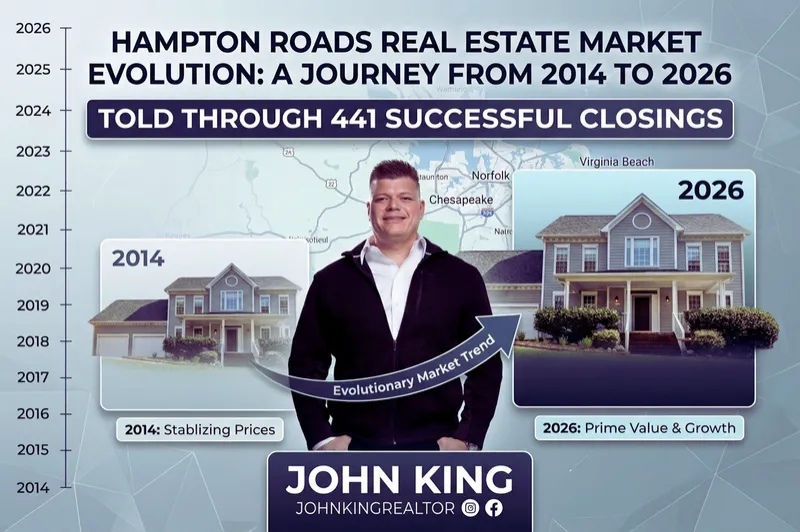
Written by John King, a U.S. Navy veteran and Berkshire Hathaway HomeServices RW Towne Realty REALTOR® with 441 closings across Hampton Roads, this library covers what buyers, sellers, and military families actually need to know about real estate in Virginia Beach, Norfolk, Chesapeake, and the surrounding 757.
Explore more than 200 original Hampton Roads real estate articles covering local neighborhoods, military PCS moves, VA loan strategy, home selling, waterfront property, market trends, and home buying — lessons drawn from more than 13 years of local transactions, not syndicated content.
Every guide is organized by topic below. Start with the cornerstone resources, browse a cluster, or scroll to the newest articles.
Start here
Start with these six cornerstone resources, then explore the supporting guides below.



Latest Hampton Roads Real Estate Articles
New guides and market updates are added every week. Newest first.
Should I Wait for Mortgage Rates to Fall Before Moving?
Only if you know what you are waiting for and what it costs you in the meantime.
That is the honest answer, and it is different from the one most homeowners are working with. The common version goes like this: rates are high, rates will come down eventually, so the smart move is to wait. Maybe. A lower rate can make a move cheaper. But prices can rise while you wait, consumer debt keeps charging interest every month, and the reasons you wanted to move do not pause while you watch the Freddie Mac survey.
Waiting is not automatically good or bad. Waiting is a strategy, and like any strategy it has a cost and a payoff. The problem is that most people waiting for rates have never priced either one. They are not waiting for something specific. They are hoping, and hope is not a plan.
I built the H.E.L.M. Check, a free stay, move or wait calculator, partly for this exact question. After it compares staying and moving with your real numbers, it projects what waiting 6, 12 or 24 months would change, under assumptions you choose. Nothing gated, nothing saved, no sign up. This article walks through the thinking behind it.
The Question Behind the Question
When a Hampton Roads homeowner tells me they are waiting for rates to fall, my first question is always the same: what number are you waiting for?
Most people do not have one. They have a feeling that rates are high, a memory of 3 percent, and a vague sense that patience will be rewarded. That is not a plan, and it leaves the decision entirely in the hands of a market nobody controls.
Here is the better version of the question. There is a specific mortgage rate at which moving and staying would cost you the same each month, given your actual home value, your equity, your debts and the home you are considering. Above that rate, staying wins on the monthly math. Below it, moving does. That number is calculable, and it is different for every household.
The H.E.L.M. Check solves for it directly. Enter your numbers and it calculates the rate, purchase price or extra down payment at which the two paths would cost the same. That break even number turns "waiting for rates to fall" from a hope into a plan: if the break even rate is realistic and nothing else is pressing, waiting can make sense. If the rate you would need is one the market is unlikely to give you, you have learned something more valuable than a forecast.
Do not predict. Stress test. Then decide.
What If Rates Fall but Prices Rise?
This is the scenario the waiting strategy almost never accounts for, and it is the most important one.
A lower rate can be offset by a higher price. If rates drop a full point and every sidelined buyer comes off the bench at once, the home you are waiting to buy may cost more than it does today, and you may be competing with far more buyers to get it. In that world, the payment on your next home barely moves, and you spent a year waiting for nothing.
The reverse can also happen. Rates can stay flat while prices soften in your target neighborhood, which quietly improves your position without a single headline about the Fed.
This is why the stress test in the calculator shows rate and price separately. Change both and see which one your situation is actually sensitive to. Some households discover their decision barely moves with rates at all, because the price of the next home or the debt they are carrying dominates the math. That discovery changes what they should be watching.
The Real Cost of Waiting
If nothing changed for another 12 months, what would that actually mean for you? For a lot of households, it means another year of:
The same commute
The same high interest debt compounding every month
The same maintenance burden
Too little space, or too much house
Being far from family
Postponing retirement plans or a PCS decision
Working extra hours to keep up with current obligations
None of those show up in a rate forecast, and every one of them is a real cost. For a household carrying expensive consumer debt, the waiting math is especially unforgiving: the interest accruing on that debt each month does not pause while you wait for a better mortgage rate. If that is your situation, the debt question may matter more than the rate question.
And for homeowners holding a low rate, the 3 percent mortgage question and the waiting question are really the same question wearing different clothes: both come down to what your whole picture looks like, not what one number does.
When Waiting Is the Smart Move
Now the other side, because waiting is not a mistake. It is a tool, and used deliberately it can be the strongest play available.
Twelve more months can give you time to:
Build cash reserves
Pay down debt
Grow equity through principal paydown
Improve your credit
Prepare the home for sale
Increase income
Decide where you actually want to live next
Notice what every item on that list has in common: each one is something you control. A waiting plan built on your own actions, pay off the card, build the reserve, finish the repairs, is a real plan with a real payoff you can measure. A waiting plan built on predicting the Federal Reserve is a coin flip with a 12 month runway.
The waiting projection in the H.E.L.M. Check is built for exactly this. Every assumption starts at zero, so nothing rises or falls unless you say so. Enter extra debt paydown, monthly savings, your own guesses on home values and rates, and see the projected picture at 6, 12 and 24 months. Then run a pessimistic version and an optimistic version and see whether the decision actually changes. Often it does not, and that is the most useful thing the tool can tell you.
Waiting and the Market You Are Waiting In
One more honest piece. The market does not wait with you.
In Hampton Roads, well prepared and well priced homes are still selling timely through the fall and winter, and the buyers in the market right now are some of the most decisive of the year. I have watched this market rewrite itself four times since my first closing, and the one constant is that the people who did best were working from their own numbers, not from a forecast.
Waiting for a better market is a bet that the future version of this market will treat you better than the current one. Sometimes that bet pays. Sometimes the window you were waiting for turns out to have been the one you were standing in.
Frequently Asked Questions
What mortgage rate would make moving worthwhile for me?
It depends on your full picture, which is why the H.E.L.M. Check solves for it. Enter your numbers and it calculates the rate, purchase price or extra down payment at which moving and staying would cost the same each month. That break even number is more useful than any forecast.
What if rates fall but prices rise?
Then a lower rate can be offset by a higher price. That is why the stress test shows rate and price separately. Change both in the calculator and see which one your situation is more sensitive to.
Should I sell and rent for a while?
For some households it creates breathing room: debt paid down, reserves rebuilt, and time to buy again when ready. It also means paying rent with no principal reduction and re-entering the market later at unknown prices and rates. Switch the calculator to rent mode to compare both versions with your numbers.
Can I sell now and buy again later?
Yes. Some households sell, rent, rebuild savings and buy again once their finances or plans settle. The tradeoff is rent with no equity growth and an unknown future price and rate. Timing a sale and purchase together is also possible, and it is a process I walk sellers through regularly.
What if staying is actually the best answer?
Then stay. The H.E.L.M. Check is built so staying can win, and it often does for homeowners with low rates, modest debt and a home that still fits. Knowing that with real numbers behind you is worth something too.
Will the calculator tell me to sell?
No. It never tells you to sell, buy or move. It shows estimated tradeoffs, explains what changed between the scenarios, and shows what would have to change for each path to make sense. The decision stays yours.
Know What You Are Waiting For
Waiting for rates is not a plan. Waiting for a specific break even number, while paying down debt and building reserves on a schedule you control, is a plan.
Start with the free H.E.L.M. Check. Run your numbers, find your break even rate, and enter your own assumptions to see what 6, 12 and 24 months of waiting would actually change. Then get a real number on your home with a free home valuation, because the comparison is only as good as the value you feed it.
And if you want the whole thing run against your actual Hampton Roads property, with current comparable sales and the homes you are considering next, reach out and tell me what you are weighing. No obligation. If the smartest move for you is to wait, I will tell you that, and I will tell you exactly what you are waiting for.
Related Reading
About The Author
John King is a U.S. Navy veteran and licensed Realtor with Berkshire Hathaway HomeServices RW Towne Realty, serving Hampton Roads including Virginia Beach, Norfolk, and Chesapeake. A designated Luxury Collection Specialist with more than 400 closings and over 13 years of local experience, he is known for a strategic, data driven approach to marketing homes and a straightforward, veteran's approach to his clients.
📱 757-270-3994
📧 [email protected]
🌐 www.757King.com
▶️ Hampton Roads Living on YouTube
Curious what your home is worth in today's market? Get a free home valuation and find out where you stand.
This article and the H.E.L.M. Check are educational real estate scenario tools. They are not financial, tax, legal or credit counseling advice, a mortgage approval, a loan estimate, an appraisal, a guarantee of sale price or proceeds, or a prediction of future home values or mortgage rates. The waiting projections reflect only the assumptions you enter, not forecasts. Every situation is different, and results depend entirely on your actual numbers. For decisions involving significant debt, consult appropriately licensed professionals.

Why these guides are different
Every article here is written by one local agent from his own transaction record, not by a content farm. The numbers below are the basis for the advice.

John King is a former Navy Machinist Mate and a licensed Virginia REALTOR® with Berkshire Hathaway HomeServices RW Towne Realty in Virginia Beach. Licensed since 2013, he has logged 441 closings across Virginia Beach, Norfolk, Chesapeake, Suffolk, Hampton, and Newport News, and specializes in military PCS relocation, VA loans, and waterfront property. He holds a 5.0 Google rating across 117 reviews and has earned the HRRA Circle of Excellence every year since 2015.
About John King See the transaction studyCommon questions about this library
Tap a question to expand it.
What is the Hampton Roads Real Estate Blog?
Which Hampton Roads neighborhoods are closest to each base?
How do VA loans work when buying in Virginia Beach or Norfolk?
What is the Hampton Roads real estate market like right now?
Should I buy or rent during a PCS to Hampton Roads?
Ready to talk about your move?
Reading is a good start. A 15-minute conversation with a local agent who has logged 441 closings in Hampton Roads is a better one.
Prefer to talk? Call or text John at (757) 270-3994.

441 Closings
Client-side closings across Hampton Roads since 2014.

189 VA-Financed Sales
Direct experience with military and veteran buyers.

270 Subdivisions
Experience spread across the whole region.

FOLLOW US


COMPANY
CUSTOMER CARE
LEGAL
Copyright 2026 John King | KingRealtor757. All Rights Reserved. Equal Housing Opportunity. REALTOR(R). Virginia License 0225211050.