







Hampton Roads Real Estate Blog & Local Market Insights
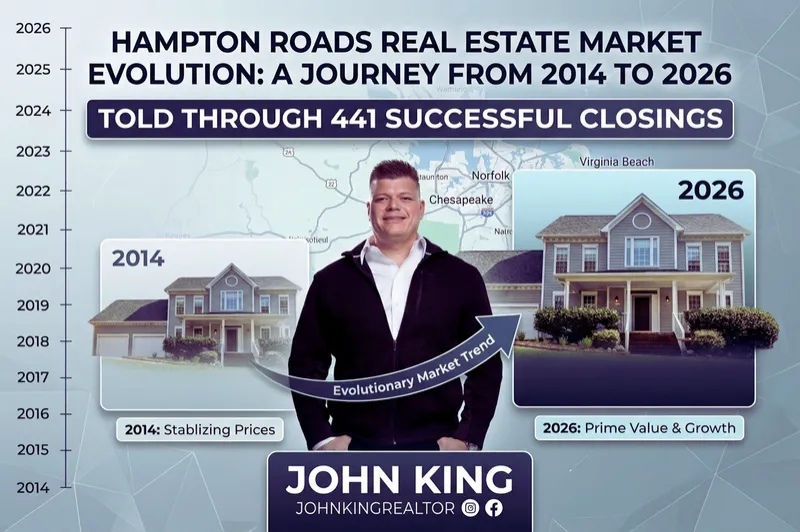
Written by John King, a U.S. Navy veteran and Berkshire Hathaway HomeServices RW Towne Realty REALTOR® with 441 closings across Hampton Roads, this library covers what buyers, sellers, and military families actually need to know about real estate in Virginia Beach, Norfolk, Chesapeake, and the surrounding 757.
Explore more than 200 original Hampton Roads real estate articles covering local neighborhoods, military PCS moves, VA loan strategy, home selling, waterfront property, market trends, and home buying — lessons drawn from more than 13 years of local transactions, not syndicated content.
Every guide is organized by topic below. Start with the cornerstone resources, browse a cluster, or scroll to the newest articles.
Start here
Start with these six cornerstone resources, then explore the supporting guides below.




Latest Hampton Roads Real Estate Articles
New guides and market updates are added every week. Newest first.

Should I Downsize If My Mortgage Rate Is Low?
Run both versions, because the answer swings on how you pay for the next house, not on the rate you are giving up.
Here is the part most homeowners get backwards. A smaller home bought largely with equity can cut your monthly costs sharply even with no mortgage rate advantage at all. A smaller home bought with a large new loan at today’s rates may save you very little, and occasionally nothing. Same downsize, same low rate surrendered, two completely different outcomes. The variable is not the rate. It is how much of the purchase your equity covers.
This comes up constantly with Hampton Roads homeowners in a familiar position: a large home, a large equity position, a growing maintenance burden, rooms nobody uses, and a mortgage rate they feel guilty about leaving. If that is you, the good news is that your situation is one of the few where the math frequently favors moving, and the reason has nothing to do with rates.
Let me show you how it actually works, and what to do about it.
Why Downsizing Breaks the Usual Rate Math
In a normal move, you sell one house and buy a comparable one. Your loan size stays roughly the same, so trading a 3 percent rate for a 7 percent rate hits you squarely. That is the arithmetic behind the lock-in effect, and it is real.
Downsizing changes the inputs. You are not replacing your loan with an equal loan. You are replacing a large house with a smaller one, and you are bringing substantial equity to the closing table. If your equity covers most of the purchase, the new loan is small, and a high rate applied to a small balance costs far less than a low rate applied to a large one.
Picture a household with a large home carrying a modest remaining mortgage balance at 3.5 percent, no other debt, and a target of something smaller. If most of the proceeds go into the next home, the mortgage interest line barely matters, and the savings show up everywhere else instead.
That is why the honest instruction is to run both versions. Model the purchase with a large down payment from equity, and model it with a conventional down payment and a bigger loan. The gap between those two outcomes is usually much wider than the gap between your old rate and today’s rate.
The Costs That Actually Move When You Downsize
Here is the other thing the rate conversation hides. Maintenance, taxes and insurance often matter as much as the rate, and sometimes more.
Maintenance scales with the house. A common planning rule of thumb is roughly 1 percent of value per year. Cut the value of the house meaningfully and that line falls with it, every year, forever. For an owner who is also paying someone else to handle what they used to do themselves, the drop is larger still.
Property taxes scale with assessed value. Virginia Beach assesses at $0.97 per $100 of assessed value, and other Hampton Roads cities differ, so check yours. A smaller assessed value means a smaller bill in perpetuity.
Insurance scales with replacement cost. Smaller home, smaller premium, and for homeowners moving out of a waterfront or older property, sometimes a much smaller premium.
Utilities scale with square footage. Less space to heat, cool and light.
Stack those four against the mortgage line and you can see why the rate is not the main event in a downsizing move. Your old loan is cheap, but it sits on top of a cost structure sized to a house you no longer need.
Running the Comparison Honestly
The H.E.L.M. Check, the free stay, move or wait calculator on my site, has a downsizing scenario built into it for exactly this. Load it and you will see the shape of the decision: a large home with a large equity position, a growing maintenance burden, and a smaller target purchase funded largely from equity.
Then change it to your numbers and run the two versions.
Version one: all available equity. Set the down payment to the full usable equity after selling costs and reserves. See what the new payment, taxes, insurance and maintenance total.
Version two: a conventional down payment. Set it to 20 percent or whatever you would otherwise put down, keep the rest in cash or investments, and compare.
Both are legitimate strategies. Putting every dollar into the house minimizes the monthly cost. Keeping more in reserve preserves flexibility and liquidity, which matters more as you get older. The calculator will not tell you which to choose. It will tell you exactly what each one costs, which is the part you cannot do in your head.
You can also switch the calculator to rent mode, because for some downsizing households, especially those unsure where they want to land next, selling and renting for a period is a real option worth pricing rather than dismissing.
Deciding Is Not the Hard Part. Sequencing Is.
Most downsizing homeowners I talk to are not actually stuck on whether. They are stuck on how, and specifically on this: do I sell first, or buy first?
Both paths work and both have a real cost.
Selling first gives you a known number. You know your actual proceeds instead of an estimate, you shop with cash in hand, and your offer on the next home is not contingent on selling, which makes it far stronger. The cost is the gap: you may need an interim rental or a temporary stay, and in a market where well prepared homes move quickly, that gap can arrive faster than you expect.
Buying first means never moving twice. The cost is uncertainty and exposure: you are carrying two homes until the first sells, and your purchase offer may need a sale contingency, which weakens it against competing offers.
Doing both at once is the third path, and it is the one most downsizing sellers actually want. It requires coordinated timelines, realistic contingency planning, and an agent who has sequenced it before. Selling and buying at the same time is a specific process, not a hope, and it is the conversation I have most often with downsizing clients.
The right sequence depends on your reserves, your risk tolerance, how fast your current home is likely to sell, and how competitive your target price band is. There is no universal answer, but there is a right answer for your situation, and it should be decided deliberately before anything goes on the market.
What Your Current Home Needs Before It Lists
One more practical piece, because downsizing sellers often own the home longest and it shows.
A home that has been lived in for fifteen or twenty five years carries deferred maintenance, dated finishes and a lot of accumulated belongings. All three affect what it sells for and how fast. The preparation that clears a clean appraisal and a strong first impression matters here, and so does the harder work of decluttering a house that holds decades of life in it.
Start that process earlier than feels necessary. The sellers who net the most are the ones who began preparing months before the sign went in the yard, not the ones who listed and then scrambled.
Frequently Asked Questions
Should I downsize if my mortgage rate is low?
Run both versions. A smaller home bought largely with equity can cut monthly costs sharply even with no mortgage advantage, while a smaller home with a large new loan at today’s rates may save very little. Maintenance, taxes and insurance often matter as much as the rate.
Does having a lot of equity mean I should sell?
No. Equity is an option, not an instruction. It matters most when it could replace expensive debt or fund a home that fits your life better. If your home fits and your debt is modest, equity can simply keep growing where it is.
Should I sell first or buy first when downsizing?
Selling first gives you a known number and a stronger non contingent offer, at the cost of a possible interim move. Buying first means moving once, at the cost of carrying two homes and a weaker contingent offer. Coordinating both at the same time is the third path, and it needs deliberate planning rather than hope.
Should I sell and rent for a while instead of buying something smaller?
For some households it creates breathing room and time to decide where they actually want to land. It also means paying rent with no principal reduction and re-entering the market later at unknown prices and rates. Switch the H.E.L.M. Check to rent mode to compare both versions with your numbers.
Can a higher mortgage rate still leave me with lower monthly payments?
Yes, and downsizing is the clearest case of it. A high rate on a small loan costs less than a low rate on a large one, and the savings in maintenance, taxes, insurance and utilities often exceed the mortgage difference entirely.
What if staying is actually the best answer?
Then stay. The H.E.L.M. Check is built so staying can win, and it often does for homeowners with low rates, modest debt and a home that still fits. If the maintenance burden is manageable and the empty rooms do not bother you, there is no prize for moving.
Your Next Two Steps
If you are weighing a downsize in Hampton Roads, do these in order.
First, get a real number on your current home. Every version of this decision starts with what the house would actually bring. Online estimates miss in both directions, and your equity figure drives everything downstream. A free home valuation built on current comparable sales gives you the number the whole plan rests on.
Second, run both purchase versions. Load the downsizing scenario in the free H.E.L.M. Check, enter your real numbers, and compare an all equity purchase against a conventional down payment. The gap between those two outcomes is the real decision.
Then, if the numbers say go, let’s talk about sequencing. Sell first, buy first, or coordinate both. That is where downsizing moves succeed or get expensive, and it is worth planning before anything lists. No obligation, no script, and if the answer is stay, I will tell you that.
Related Reading
About The Author
John King is a U.S. Navy veteran and licensed Realtor with Berkshire Hathaway HomeServices RW Towne Realty, serving Hampton Roads including Virginia Beach, Norfolk, and Chesapeake. A designated Luxury Collection Specialist with more than 400 closings and over 13 years of local experience, he is known for a strategic, data driven approach to marketing homes and a straightforward, veteran’s approach to his clients.
📱 757-270-3994
📧 [email protected]
🌐 www.757King.com
▶️ Hampton Roads Living on YouTube
Curious what your home is worth in today’s market? Get a free home valuation and find out where you stand.
This article and the H.E.L.M. Check are educational real estate scenario tools. They are not financial, tax, legal or credit counseling advice, a loan estimate, an appraisal, a guarantee of sale price or proceeds, or a prediction of future home values or mortgage rates. Property tax rates, insurance costs and maintenance estimates vary by city, property and insurer; verify your own. Results depend entirely on the numbers you enter. For decisions involving significant assets or debt, consult appropriately licensed professionals.

Why these guides are different
Every article here is written by one local agent from his own transaction record, not by a content farm. The numbers below are the basis for the advice.

John King is a former Navy Machinist Mate and a licensed Virginia REALTOR® with Berkshire Hathaway HomeServices RW Towne Realty in Virginia Beach. Licensed since 2013, he has logged 441 closings across Virginia Beach, Norfolk, Chesapeake, Suffolk, Hampton, and Newport News, and specializes in military PCS relocation, VA loans, and waterfront property. He holds a 5.0 Google rating across 117 reviews and has earned the HRRA Circle of Excellence every year since 2015.
About John King See the transaction studyCommon questions about this library
Tap a question to expand it.
What is the Hampton Roads Real Estate Blog?
Which Hampton Roads neighborhoods are closest to each base?
How do VA loans work when buying in Virginia Beach or Norfolk?
What is the Hampton Roads real estate market like right now?
Should I buy or rent during a PCS to Hampton Roads?
Ready to talk about your move?
Reading is a good start. A 15-minute conversation with a local agent who has logged 441 closings in Hampton Roads is a better one.
Prefer to talk? Call or text John at (757) 270-3994.

441 Closings
Client-side closings across Hampton Roads since 2014.

189 VA-Financed Sales
Direct experience with military and veteran buyers.

270 Subdivisions
Experience spread across the whole region.

FOLLOW US


COMPANY
CUSTOMER CARE
LEGAL
Copyright 2026 John King | KingRealtor757. All Rights Reserved. Equal Housing Opportunity. REALTOR(R). Virginia License 0225211050.