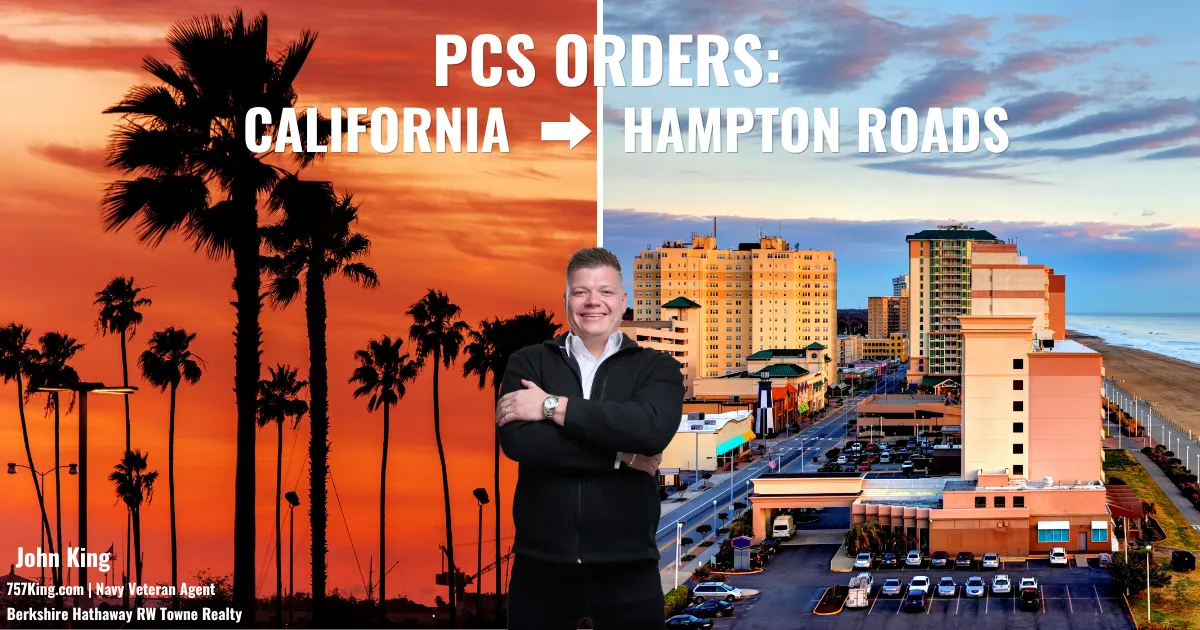
From California to Hampton Roads: A Military Family's Practical Guide
You're at Naval Base San Diego. Or NAS Lemoore. Or NAS North Island in Coronado. Or Naval Air Weapons Station China Lake. Or Camp Pendleton, Twentynine Palms, Edwards, Travis, Vandenberg, MCAS Miramar, NWS Seal Beach. The orders just dropped. Hampton Roads, Virginia.
If you're like most California-to-Virginia PCS families I work with, your first reaction was a mix of curiosity, mild geographic confusion, and a quiet sigh of relief about what your housing money is about to do.
I'm John King. Navy veteran, licensed agent with Berkshire Hathaway RW Towne Realty serving all of Hampton Roads. California to Virginia is genuinely one of the most positive PCS transitions a service member can make on the cost-of-living front, but there are real adjustments to think through. Here's what you actually need to know.
The Headline: Your Housing Money Goes Dramatically Further Here
The single biggest difference between California and Hampton Roads is what your housing budget buys.
San Diego County median home price currently runs around $900,000 to $1 million depending on the neighborhood. The Bay Area is significantly higher. Even Lemoore and the Central Valley markets have moved up substantially over the past several years.
Hampton Roads median home prices currently run in the mid-$300s regionally. Virginia Beach trends higher, with most established neighborhoods running mid-$400s to mid-$700s. Norfolk and Chesapeake offer more accessible price points across many neighborhoods. Waterfront and oceanfront properties exist at price points that would not be possible in coastal California.
For a typical California military family with E-7 to O-4 income, the move from Coronado, San Diego, or Lemoore to Hampton Roads often means going from "renting because we can't afford to buy" to "buying a home with real square footage and a yard." That's not a marginal lifestyle change. That's a structural one.
The Tax Picture Changes Significantly
This is the second-biggest practical difference and most California service members don't fully appreciate it until their first Virginia paycheck arrives.
California state income tax tops out at 13.3%, the highest in the United States. Active duty service members domiciled in California pay California income tax on military pay regardless of where stationed.
Virginia state income tax tops out at 5.75% on income over $17,000.
If you maintain California as your domicile (legal state of residence) while stationed in Virginia, the Servicemembers Civil Relief Act prevents Virginia from taxing your military pay, but California will still tax it. Some California military families consider changing domicile to a no-income-tax state during their PCS, which is a separate strategic decision worth discussing with a tax professional.
If you change your domicile to Virginia, your military pay becomes Virginia-taxable at up to 5.75%. Still significantly less than California's 13.3% ceiling.
The personal property tax piece works similarly to the Florida case. Virginia personal property tax on vehicles in Hampton Roads runs roughly $4.00 to $4.33 per $100 of assessed value. If you maintain a non-Virginia domicile under SCRA and file the proper paperwork with your local Commissioner of the Revenue, you can be exempted on vehicles registered in your name. On a $40,000 vehicle, that's potentially $1,600 to $1,700 per year saved annually if your SCRA exemption is properly filed.
Important caveat: tax situations are individual and complex. Verify your specific California-to-Virginia situation with your installation's legal assistance office or a tax professional before making domicile decisions.
What's the Same About California and Hampton Roads
Both are coastal. Hampton Roads has roughly 200 miles of shoreline across the Atlantic, the Chesapeake Bay, and the river systems. If you've been at North Island, Coronado, or anywhere along the California coast, the lifestyle of being near water translates directly.
Both are heavily military. California has the largest active duty population in the country. Virginia has the largest concentration east of the Mississippi. The community feel, the network effect of military families, and the support infrastructure all carry over.
Both have significant Navy and Marine Corps presence. If you've been part of the surface warfare, naval aviation, or amphibious community in California, your professional community has a parallel presence in Hampton Roads.
What's Different (And What You Need to Plan For)
Humidity Is Real Here
This is the cultural shock most California service members don't see coming. California's coastal climate is dry. Hampton Roads is humid, sometimes oppressively so, from May through September. Summer afternoons reach high heat index values. Pop-up thunderstorms are common. Air conditioning is a year-round expectation, not a luxury.
If you've been in San Diego, Coronado, or NAS Lemoore, this is the single biggest physical adjustment to plan for. It affects how you dress, how you exercise outdoors, how you maintain your home (mold, mildew), and how you think about HVAC systems when you're house hunting.
Real Winter, Real Spring, Real Fall
Hampton Roads has four actual seasons. Average January high around 49°F. Average low around 32°F. Snow most years, sometimes substantial. Spring with pollen blooms in March and April. Fall with genuine color in October and November.
If you've been in coastal California where the temperature variance over the year is roughly 15-20 degrees, the seasonal swing here is a real lifestyle change. Some families love it. Some miss the consistent California climate forever. Worth knowing before you fall in love with the lower price point.
Hurricane and Coastal Flood Risk
Hampton Roads sits on a low-lying coastal plain. Hurricanes and tropical storms affect this region from June through November. Storm surge is the bigger flood concern than rainfall. Some neighborhoods sit in FEMA flood zones that require flood insurance. Your agent should pull flood zone designations on every home you consider, similar to how earthquake risk affects California real estate decisions.
This is a different risk profile than California's earthquake and wildfire risks, but it is a risk profile, and your insurance picture changes accordingly.
The Tunnel Commute Reality
Hampton Roads has tunnels under the harbor and bay connecting the South Side (Norfolk, Virginia Beach, Chesapeake) to the Peninsula (Hampton, Newport News, Williamsburg). The Hampton Roads Bridge-Tunnel and the Monitor-Merrimac Memorial Bridge-Tunnel are the major arteries. During rush hour, accidents in the tunnels create traffic backups that don't have parallels on Southern California freeways. If your base is on the opposite side of a tunnel from where you're considering buying, that commute defines your daily life.
The good news: most Hampton Roads commutes are dramatically shorter than equivalent California metro commutes. The bad news: the worst tunnel days are genuinely bad.
Schools
Virginia public schools are strong overall and are governed by the Virginia Department of Education. School accreditation status and assessment data are publicly available. Virginia uses Standards of Learning (SOL) assessments. Your child's California academic record will transfer cleanly, but the testing structure is different and there may be a brief placement adjustment.
The school zone for any home you consider should be a major factor in your decision. Local schools vary significantly within each city.
Cost of Living Beyond Housing
Beyond housing, the cost of living differential is more modest but still favorable to Hampton Roads:
Gas prices in Virginia run notably lower than in California, often by $1+ per gallon at peak.
Groceries are roughly comparable to slightly cheaper.
Auto insurance is generally cheaper in Virginia than in California metros.
Utilities are roughly comparable, though heating costs in winter are real here in a way they aren't in coastal California.
Restaurants and entertainment are typically less expensive across the board.
The combination of dramatically cheaper housing plus modestly cheaper everything else means the discretionary income picture for most California service members improves significantly after the move.
Vehicle Registration and Driver's Licenses
If you maintain California domicile under SCRA, you can typically keep California-registered vehicles and California driver's licenses while stationed in Virginia. File the personal property tax exemption paperwork with your local Commissioner of the Revenue.
If you decide to switch domicile to Virginia, you'll register vehicles with Virginia DMV. Virginia vehicle registration is generally less expensive than California's, but you'll become subject to Virginia's personal property tax on those vehicles.
Domicile is a meaningful financial decision worth discussing with your legal assistance office before defaulting either way. California tax obligations don't disappear just because you're stationed elsewhere if California remains your domicile.
PCS Timing From California to Hampton Roads
Coast-to-coast PCS moves are major undertakings. A few practical points specific to this corridor:
The drive across the country runs roughly 5 to 7 days depending on route, family situation, and how aggressive you want to be with daily mileage. Most California-to-Virginia PCS moves are partial DITY (do-it-yourself move) or full government move with a POV drive.
Allow 14 to 21 days for HHG (household goods) shipment from California origins to Hampton Roads. Sometimes longer in peak PCS season.
If you're moving in summer, hotel availability along your route gets thin quickly. Book ahead.
Many California service members opt to fly the family to Hampton Roads while one spouse drives the POV across country. That logistical pattern works well if you're closing on a home before arrival.
How to Set Yourself Up Before You Leave California
Get pre-approved with a Hampton Roads VA-savvy local lender before you start looking. Out-of-state online lenders consistently underperform on closing timelines for Hampton Roads VA purchases.
Engage a real Hampton Roads agent who has actually closed VA loans here recently and who can do thorough virtual tours, FaceTime walkthroughs, and honest property assessments. The cross-country distance makes the agent relationship the single most important variable in your purchase.
Pull your VA Certificate of Eligibility now.
Many California-to-Virginia military families purchase their Hampton Roads home sight unseen via virtual tours. It works extremely well when the agent is doing it right.
Bottom Line
California to Hampton Roads is one of the most financially favorable PCS moves in the military. Your housing money goes dramatically further, your tax burden generally drops, and you trade Southern California's costs for an East Coast quality of life with four real seasons, genuine humidity in summer, and a coastal lifestyle that doesn't require the price tag attached.
The adjustments are real (winter, humidity, tunnel commute, hurricane awareness), but they're manageable, and most California military families find the trade more than worth it.
If you've got orders to Hampton Roads from a California base and you want to talk through your housing situation, your timeline, and what your money will actually buy here, let me know. I'll walk you through neighborhoods, run the numbers, connect you with my trusted local VA lender, and help you do virtual tours from wherever you are.
When it's time to talk real estate, you know who to call.
If a PCS move is coming, see the full military PCS playbook, built on documented case studies of real Hampton Roads transactions.
About the Author
John King is a Navy veteran and licensed real estate agent with Berkshire Hathaway RW Towne Realty, serving Hampton Roads including Virginia Beach, Norfolk, and Chesapeake. Known for straightforward approach and market expertise.
📞 757-270-3994 📧 [email protected] 🌐 www.757King.com
Curious what your home is worth in today's market? Get a free home valuation and find out where you stand.
Related guides from John King
Written by John King, Navy veteran & REALTOR®, Berkshire Hathaway HomeServices RW Towne Realty · (757) 270-3994 · About John
